Conservative Ladies’ Dinner in Brussels
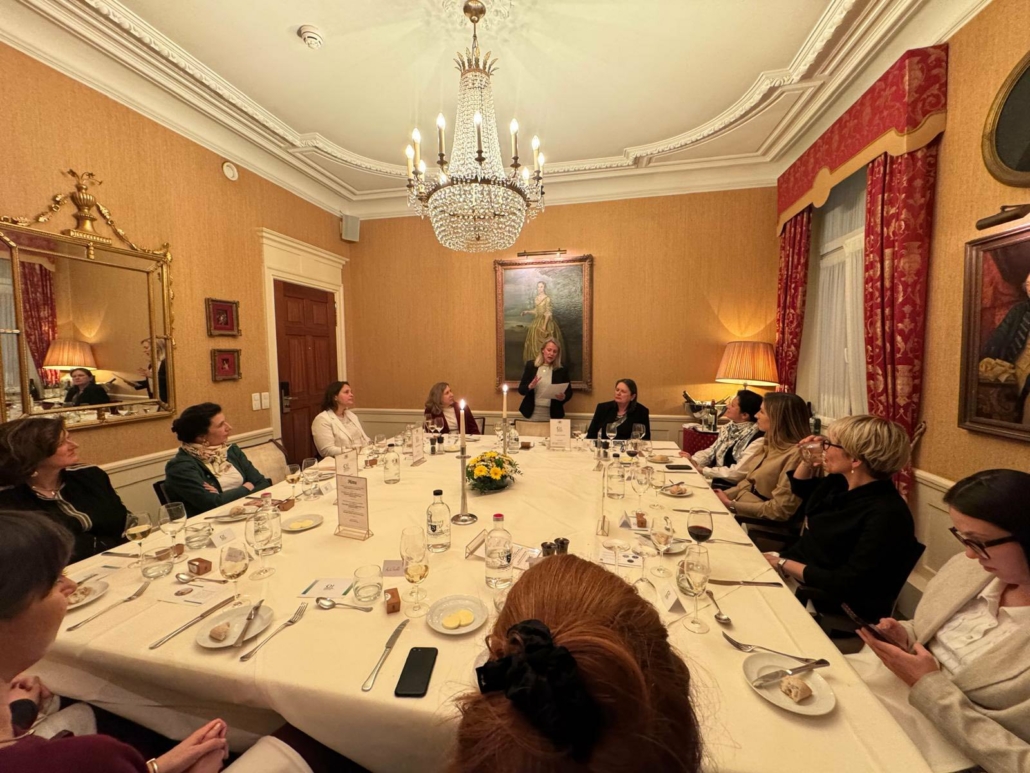
The Christian Democratic Institute organised a dinner in Brussels titled “Living in a Civilizational Moment – Challenges and Opportunities.” The event brought together invited guests for a discussion on the civilizational challenges and opportunities facing Europe today.
The keynote address was delivered by Ellen Kryger Fantini, managing editor and co-founder of The European Conservative. The evening was hosted by Dr. Andreja Valič Zver, President of the Board of Trustees of the Christian Democratic Institute.
LIVING IN A CIVILIZATIONAL MOMENT
Ellen Fantini
25 March 2026, Brussels
- WE ARE NOT LIVING IN NORMAL TIMES
Ladies, thank you. It is a particular honour to be in Brussels — the capital of Europe, as they tell us — speaking to a room of women who have chosen not to look away.
I want to begin by saying something plainly, without qualification, without the diplomatic hedging that this city is so famous for: we are not living through normal times. This is not another turn of the political cycle, not another pendulum swing between centre-left and centre-right. We are living through something far more serious. A civilizational moment.
The institutions that governed post-war Europe are cracking. The certainties our parents and grandparents lived by — about nationhood, about family, about what a human being is — are being contested at the root. The very words we use — woman, mother, nation, faith — have become battlegrounds. If you had told Margaret Thatcher in 1980 that one day a British Prime Minister would struggle to define the word ‘woman’, they would have thought you were describing a television comedy. We are living in that farce.
Now, the temptation — and I understand it, I feel it myself — is to treat all of this as primarily a political problem. To think: if only we elect the right people, block the right directives, win the right court cases, all will be well. That temptation is understandable. It is also dangerously incomplete.
Because, as we hear over and over, politics is downstream from culture. But culture — and this is what we do not say often enough, even on our side — is downstream from the spiritual. If we do not understand that chain, we will keep fighting at the wrong level. We will keep winning battles while losing the war.
- THE CHAIN: SPIRITUAL → CULTURAL → POLITICAL
Let me walk through that argument, because it matters enormously for how we think about what we are doing here and why.
How we got here
The crisis we face did not begin in parliaments. It began in the seminaries, the universities, the schools, and eventually the living rooms — with the slow erosion of a shared understanding of who we are and what we are for. Of the human person made in the image of God. Of transcendent truth that exists whether we acknowledge it or not. Of what we owe one another, our ancestors, our children, and our Creator.
When you hollow out the spiritual foundations, the cultural forms built on top of them begin to lose their meaning. Marriage becomes a contract of convenience rather than a covenant. Art loses its capacity for beauty and becomes a vehicle for ideology. Education stops transmitting wisdom and starts producing consumers and activists. Community life, stripped of shared ritual and shared belief, atomizes into mutual suspicion.
And when the culture is hollowed out, politics fills the vacuum. The state expands to replace what the family and the church once provided. And it is weaponized — eagerly, ruthlessly — by those who never wanted tradition in the first place.
Why political victories alone won’t hold
We have seen this in our own lifetimes. Electoral wins — genuine, important ones — have been reversed, neutered, or simply overwhelmed by the machinery of culture. A conservative government gets elected, and the schools still teach the same things. The BBC still sets the agenda. The judiciary still finds reasons to block common sense. The HR departments of every major corporation still enforce an ideology that most people never voted for and never wanted.
Political change that is not rooted in cultural renewal is like building on sand. You can put up an impressive structure. But when the tide comes in, it washes away. We have watched it wash away, again and again.
What this means for us
If the spiritual is the deepest layer — and I believe it is — then recovering it is not a luxury. It is not a nice add-on for the religious people in the room while the serious strategists get on with the real work. It is the precondition for everything else.
I am not calling for a theocracy. I am not saying that everyone in this movement must share the same faith or the same prayers. I am saying something more basic: that a civilization which has cut itself off from any sense of the transcendent, from any source of meaning and obligation beyond the individual, cannot hold. History is very clear on this point. Civilizations draw their life from somewhere beyond themselves. Europe drew its from Jerusalem and Athens and Rome. When it forgets that, it does not become neutral. It becomes vulnerable.
III. THE CHALLENGE: WHAT IS BEING DESTROYED
So what, concretely, is under attack? Let me be specific, because vague talk of ‘civilizational decline’ can become an excuse for not naming things. I want to name things.
The human person
The transgender ideology is perhaps the most radical assault on anthropological reality in living memory. It is not, at its core, about bathrooms or pronouns or legal categories — though all of those matter. It is about something deeper: whether reality itself can be renegotiated by act of will. Whether a man can become a woman by declaring it so. Whether the body means anything, or whether it is simply raw material for self-invention.
When the UK Supreme Court ruled last year — unanimously — that a woman means an adult human female, it was not making a controversial philosophical claim. It was stating what every culture in human history has known. And yet we needed five Supreme Court justices to say it, because an ideology had spent years insisting otherwise, and institutions had capitulated one by one, out of cowardice or confusion or careerism.
The women who fought that case — the ‘three extraordinary, tenacious Scottish women’ as J.K. Rowling rightly called them — are a model for what this civilizational moment asks of us. Hold the line. Tell the truth. Do not be bullied into pretending that what is false is true.
The safety of women — and the silence around it
There is something deeply revealing about a political class that claims to champion women while presiding over conditions that have made European streets measurably less safe for them.
The mass sexual assaults in Cologne on New Year’s Eve 2015. The rape gangs in Rotherham, Rochdale, Telford and now, it seems, in France, Germany and who knows where else— thousands of girls, predominantly from the working class, abused over decades while authorities looked away, afraid of being called racist. The explosion of rape statistics in Sweden and Germany that tracked almost precisely with the periods of highest uncontrolled migration. These are not coincidences. They are consequences.
And yet, to say so plainly is still treated in polite circles as a kind of indecency. The women who have suffered are sacrificed twice: first by the perpetrators, and then by the ideologues who insist that acknowledging the pattern is more dangerous than the pattern itself. This is not compassion. It is cowardice dressed as virtue.
I believe in the dignity of every human person. That belief is precisely why we insist on borders, on integration standards, on the rule of law, and on an honest accounting of what uncontrolled mass migration has cost. A civilization that cannot protect its women has already lost something essential. A political establishment that will not name the problem cannot solve it. And the women in this room should not be afraid to say so.
The family
Across Europe, birthrates are in freefall. Not, I would argue, primarily because women do not want children. But because the culture has ceased to honour, support, and celebrate the vocation of motherhood. Because it tells young women that a career is an identity and a child is a lifestyle choice. Because housing costs and economic insecurity make family formation feel impossible. Because a certain kind of feminism spent fifty years telling women that the domestic was beneath them, and now wonders why the cradles are empty.
The welfare state cannot replace what the family provides. No bureaucracy can substitute for the particular, irreplaceable love of a mother. And no civilization has ever survived a sustained collapse of the family. We should be alarmed. We are not alarmed enough.
Religious memory
Europe’s cathedrals have become museums. Its feast days have become shopping opportunities. Its founding stories — Hebrew and Christian, Greek and Roman — are taught, when they are taught at all, as objects of suspicion. Colonialism, patriarchy, oppression: that is the frame through which the next generation is being asked to view their own inheritance.
A civilization that is ashamed of where it came from does not know where it is going. And a civilization that teaches its children to despise their heritage is not being progressive. It is committing a kind of cultural suicide.
Free expression and honest speech
And here in Brussels, of all places, we know what happens when you try to say these things out loud. The NatCon episode — a conference of conservatives, here in the capital of Europe, shut down by a city mayor before the courts overruled him — was not a footnote. It was a signal. Those who hold power in these institutions will use that power to silence dissent. They will dress it up in the language of safety and inclusion. But what they mean is: we will not tolerate those who disagree.
That is not democracy. And we should not pretend that it is.
- THE OPPORTUNITY: WHAT IS BEING BORN
I have named the challenges. And I do not want to minimize them. But I want to insist — and this matters especially in a room of women, who are, in my experience, builders by instinct — that this is not a counsel of despair.
Because civilizational moments are not only moments of destruction. They are also moments of clarification and creation. And I see creation happening. Let me tell you what I see.
The great sorting
In moments of civilizational stress, the serious people separate from the merely comfortable. The nominal from the actual. The people who call themselves conservative because it is socially convenient from the people who are conservative because they believe something.
That sorting is painful. It means losing allies who preferred the comfort of consensus. It means standing in rooms where you are the awkward one, the one who says the wrong thing, the one who did not get the memo about what is now unsayable. But it is also clarifying. And it is the condition for something genuine to grow. You cannot build on foundations that are half-rotten. Better to know what you actually have to work with.
The cultural rebuilding is already underway
New institutions are forming. Publishing houses that will print what the mainstream will not. Schools and academies that teach the Western canon without apology. Parishes coming back to life. Communities forming around shared convictions rather than shared postcodes. Magazines — and yes, I am allowed to mention that The European Conservative is one of them — that cover what the legacy media ignores or distorts.
People are homeschooling. They are founding small classical academies. They are having children — deliberately, countercultural as that has become. They are writing seriously, composing music, making art that aspires to beauty rather than provocation. They are building, quietly and stubbornly, the institutions of a renewal that has not yet announced itself but is already underway.
Nostalgia is passive. This is construction. And it is happening across Europe, including here.
The particular role of women
I want to dwell on this for a moment, because it speaks directly to the women in this room.
Women have always been the primary transmitters of culture. Not exclusively — of course not. But primarily. Through the raising of children, through the maintenance of memory, through the cultivation of beauty and warmth in domestic life and in civic life. The stories that get passed down. The prayers that get taught. The habits and the values and the loves that form the next generation. These pass, more often than not, through women.
This is not a diminishment. It is an enormous power. And I would argue it is the most consequential power in any civilizational moment: the power to shape what the next generation believes about the world, about themselves, about what is worth living for.
The women in this room hold more civilizational influence than any think tank or parliamentary group. The question is whether you know it, and whether you will use it.
The spiritual hunger
And finally — this may be the most surprising thing I say today, but I believe it — something is stirring spiritually. The bankruptcy of secular progressivism is generating its own backlash, and it is not only political.
Young people, in numbers that are genuinely remarkable, are turning toward transcendence. Toward meaning. Toward liturgy and beauty and permanence. Church attendance among young men in America is rising for the first time in a generation. The appetite for serious theology, for contemplative practice, for the old forms — it is there. The disenchanted world has failed to satisfy, because it was always going to fail to satisfy. Human beings are not built for a purely material existence, and at some level they know it.
Something is stirring. We should not miss it. And we should not be embarrassed to name it as the most important thing.
- THE TENSION: PRESERVING AND BUILDING
I want to address something honestly, because I think it is a genuine tension in the conservative vocation — and not one that resolves neatly.
We are asked both to conserve what is irreplaceable and to build new things adequate to a new moment. To be custodians of the past and architects of the future. And these are not the same thing. They sometimes pull in opposite directions. The custodian instinct says: do not change what works, do not experiment with what is sacred. The builder instinct says: the world has changed, and our response must change with it.
Both instincts are right. Both, taken alone, are wrong.
We cannot simply restore. The world of 1950 or 1850 is not coming back, and pretending otherwise is not conservatism — it is fantasy. And not everything that is old and established is good: The New York Times is one example! We need new institutions, new cultural forms, new ways of transmitting old truths. The faith that built the cathedrals of Chartres and Cologne must now also build schools and publishing houses and media operations and political movements suited to the twenty-first century. The same spirit, in new vessels.
I am not, I should say, a great admirer of Peter Thiel in all things. But he is onto something when he argues that real progress means going from zero to one — not copying what exists, but creating something genuinely new. That is what the people building these institutions are doing. They are not photocopying the 1950s. They are taking the permanent things — faith, beauty, truth, family — and building with them in forms the world has not quite seen before. From zero to one. That is worth paying attention to.
But, we cannot simply innovate. The track record of those who abandoned tradition in order to be relevant is not encouraging. They made themselves relevant to a moment that passed. And they are now irrelevant — or worse, captured by the very forces they thought they were cleverly engaging.
Roots are not a prison. They are what allows a tree to grow tall. The traditions we preserve — the liturgies, the stories, the moral intuitions, the accumulated wisdom of centuries — are not obstacles to building. They are the soil in which anything durable must be planted. Without them, you are not building. You are decorating.
- CLOSE: WHAT WE ARE CALLED TO DO
Let me close with this.
We are not spectators of this civilizational moment. We are participants. History will not remember those who watched carefully from a safe distance and wrote thoughtful commentary. It will remember those who built something, who held something, who refused to surrender something when surrender would have been so much easier.
The women in this room — as mothers, as professionals, as citizens, as believers — are not on the margins of this struggle. You are at its center. Not because politics needs more women, though it does. But because culture needs what women, at their best, have always provided: continuity, memory, love that is both fierce and patient, the refusal to let the essential things slip away.
The battlelines are being drawn. What we build in our homes, in our communities, in our publications, in our friendships, in our prayers — it matters. It matters more than any election. More than any directive out of Brussels. Because elections come and go, and directives can be reversed. But a civilization that has recovered its memory, its faith, its sense of what it is and what it is for — that is something that endures.
We are not living through the end of something. We are living, I believe, through the birth pangs of something new — a renewal that is not yet fully visible but is already being made, quietly, by people like you.
